

Poetic Devices In The Raven
This popular narrative poem is written in the start person. 'The Raven' personifies the feeling of intense grief and loss, while other symbols throughout the poem reinforce a melodramatic mood that emphasizes the chief character's grief and loss. 'The Raven' explores the world of emotional wars that individuals face up in all walks of life; specifically, the fight 1 can never ignore, the fight of control over the emotions of grief and loss. These battles are non physical, but leave scarring and bruising only every bit if they were. Poe has produced a wonderful piece of work that resonates with the feelings and experiences of every reader that comes across this poem.
The Raven Edgar Allan Poe Once upon a midnight dreary, while I pondered, weak and weary, Over many a quaint and curious book of forgotten lore— While I nodded, virtually napping, of a sudden there came a borer, As of some one gently rapping, rapping at my chamber door. "'Tis some visitor," I muttered, "tapping at my chamber door— Merely this and nothing more." Ah, distinctly I recollect it was in the bleak December; And each separate dying ember wrought its ghost upon the floor. Eagerly I wished the morrow;—vainly I had sought to borrow From my books surcease of sorrow—sorrow for the lost Lenore— For the rare and radiant maiden whom the angels name Lenore— Nameless here for evermore. And the silken, sad, uncertain rustling of each majestic curtain Thrilled me—filled me with fantastic terrors never felt earlier; And so that at present, to still the beating of my heart, I stood repeating "'Tis some visitor entreating entrance at my sleeping accommodation door— Some late visitor entreating entrance at my sleeping room door;— This it is and nothing more than." Presently my soul grew stronger; hesitating and so no longer, "Sir," said I, "or Madam, truly your forgiveness I implore; But the fact is I was napping, so gently you came rapping, So faintly you came tapping, tapping at my sleeping room door, That I scarce was sure I heard you"—here I opened wide the door;— Darkness there and nothing more. Deep into that darkness peering, long I stood there wondering, fearing, Doubting, dreaming dreams no mortal ever dared to dream earlier; But the silence was unbroken, and the stillness gave no token, And the just discussion there spoken was the whispered discussion, "Lenore?" This I whispered, and an echo murmured back the discussion, "Lenore!"— Merely this and nothing more. Back into the chamber turning, all my soul within me burning, Soon again I heard a borer somewhat louder than before. "Surely," said I, "surely that is something at my window lattice; Let me encounter, so, what thereat is, and this mystery explore— Let my centre be however a moment and this mystery explore;— 'Tis the wind and aught more!" Open hither I flung the shutter, when, with many a flirt and flutter, In at that place stepped a stately Raven of the saintly days of yore; Not the least obeisance made he; non a minute stopped or stayed he; Simply, with mien of lord or lady, perched above my bedroom door— Perched upon a bust of Pallas simply to a higher place my chamber door— Perched, and saturday, and nix more. And then this ebony bird beguiling my deplorable fancy into grinning, By the grave and stern decorum of the countenance it wore, "Though thy crest be shorn and shaven, yard," I said, "art sure no craven, Ghastly grim and aboriginal Raven wandering from the Nightly shore— Tell me what thy lordly name is on the Night's Plutonian shore!" Quoth the Raven "Nevermore." Much I marvelled this ungainly fowl to hear discourse then plainly, Though its reply lilliputian pregnant—little relevancy diameter; For we cannot assist agreeing that no living man Ever nonetheless was blessed with seeing bird above his chamber door— Bird or beast upon the sculptured bust in a higher place his chamber door, With such name as "Nevermore." But the Raven, sitting lone on the placid bosom, spoke only That 1 word, every bit if his soul in that one word he did outpour. Aught farther and then he uttered—non a feather so he fluttered— Till I scarcely more than muttered "Other friends take flown earlier— On the morrow he will go out me, as my Hopes have flown before." Then the bird said "Nevermore." Startled at the stillness broken past respond so aptly spoken, "Doubtless," said I, "what it utters is its but stock and store Caught from some unhappy principal whom unmerciful Disaster Followed fast and followed faster till his songs one burden bore— Till the dirges of his Hope that melancholy burden bore Of 'Never—nevermore'." Simply the Raven all the same beguiling all my fancy into smiling, Direct I wheeled a cushioned seat in front of bird, and bosom and door; Then, upon the velvet sinking, I betook myself to linking Fancy unto fancy, thinking what this ominous bird of yore— What this grim, ungainly, ghastly, gaunt, and ominous bird of yore Meant in husky "Nevermore." This I sat engaged in guessing, but no syllable expressing To the fowl whose fiery eyes now burned into my bust's core; This and more I sabbatum divining, with my head at ease reclining On the absorber'south velvet lining that the lamp-light gloated o'er, But whose velvet-violet lining with the lamp-light gloating o'er, She shall press, ah, nevermore! And so, methought, the air grew denser, perfumed from an unseen censer Swung by Seraphim whose foot-falls tinkled on the tufted floor. "Wretch," I cried, "thy God hath lent thee—past these angels he hath sent thee Respite—respite and nepenthe from thy memories of Lenore; Carouse, oh quaff this kind nepenthe and forget this lost Lenore!" Quoth the Raven "Nevermore." "Prophet!" said I, "thing of evil!—prophet still, if bird or devil!— Whether Tempter sent, or whether tempest tossed thee here ashore, Desolate yet all undaunted, on this desert country enchanted— On this home by Horror haunted—tell me truly, I implore— Is there—is there balm in Gilead?—tell me—tell me, I implore!" Quoth the Raven "Nevermore." "Prophet!" said I, "affair of evil!—prophet still, if bird or devil! By that Heaven that bends to a higher place united states—by that God we both adore— Tell this soul with sorrow laden if, within the distant Aidenn, It shall clasp a sainted maiden whom the angels proper noun Lenore— Clasp a rare and radiant maiden whom the angels name Lenore." Quoth the Raven "Nevermore." "Exist that word our sign of departing, bird or fiend!" I shrieked, upstarting— "Get thee back into the tempest and the Night's Plutonian shore! Leave no blackness plume as a token of that lie thy soul hath spoken! Go out my loneliness unbroken!—quit the bust to a higher place my door! Take thy beak from out my heart, and take thy form from off my door!" Quoth the Raven "Nevermore." And the Raven, never flitting, still is sitting, yet is sitting On the pallid bust of Pallas just above my sleeping room door; And his eyes take all the seeming of a demon'southward that is dreaming, And the lamp-calorie-free o'er him streaming throws his shadow on the floor; And my soul from out that shadow that lies floating on the floor Shall be lifted—nevermore!
Summary
'The Raven' by Edgar Allan Poe is a dark and mysterious poem in which the speaker converses with a raven.
Throughout the poem, the poet uses repetition to emphasize the mysterious knocking occurring in the speaker's home in the middle of a common cold December evening. The speaker tries to ignore it and convince himself that in that location'south no one there. But, eventually, he opens the door and looks into the darkness, wondering if information technology could exist his love, Lenore, returned to him. No ane is there but a raven does wing into his room. It speaks to him, using only the discussion "Nevermore." This is its response to everything the speaker asks of it.
Finally, the speaker decides that angels take caused the air to fill in density and wonders if they're there to relieve him of his pain. The bird answers "Nevermore" and it appears the speaker is going to live forever in the shadow of the bust of Pallas above his door.
Themes
In'The Raven,'Poe engages themes that include death and the afterlife. These ii are some of the well-nigh common themes used throughout Poe's oeuvre. These themes are accompanied by memory, loss, and the supernatural. throughout the piece, the reader gets the sense that something terrible is about to happen, or has just happened, to the speaker and those effectually him.
These themes are all emphasized by the speaker'southward loneliness. He's solitary in his dwelling house on a cold evening trying to ignore the "rapping" on his sleeping accommodation door. By the end, it appears that he will alive forever in the shadow of decease and sorrow.
Structure and Form
'The Raven'by Edgar Allan Poe is a ballad fabricated up of eighteen half-dozen-line stanzas. Throughout, the poet uses trochaic octameter, a very distinctive metrical grade. He uses the outset-person betoken of view throughout, and a very consistent rhyme scheme of ABCBBB. In that location are a big number of words that use the same ending, for instance, the "ore" in "Lenore" and "Nevermore." Epistrophe is also present, or the repetition of the same word at the end of multiple lines.
Literary Devices
Poe makes use of several literary devices in'The Raven.'These include but are not limited to repetition, ingemination, and caesura. The latter is a formal device, one that occurs when the poet inserts a interruption, whether through meter or punctuation, into the eye of a line. For example, line three of the first stanza. It reads: "While I nodded, almost napping, suddenly there came a borer." There are numerous other examples, for instance, line 3 of the second stanza which reads: "Eagerly I wished the morrow;—vainly I had sought to borrow."
Alliteration is one kind of repetition that's used in'The Raven.'It occurs when the poet repeats the same consonant audio at the commencement of multiple words. For case, "weak and weary" in the first line of the poem and "soul" and "stronger" in the first line of the quaternary stanza.
Throughout, Poe uses repetition more broadly too. For case, his employ of parallelism in line construction and wording, likewise as punctuation. He likewise maintains a very repetitive rhythm throughout the poem with his meter and rhyme scheme.
Detailed Analysis
First Stanza
Once upon a midnight dreary, while I pondered, weak and weary,
Over many a quaint and curious book of forgotten lore—
While I nodded, nearly napping, suddenly at that place came a tapping,
Equally of some i gently rapping, rapping at my bedchamber door.
"'Tis some company," I muttered, "borer at my bedroom door—
Only this and nada more."
The opening line of this poem proves to be quite theatrical; initiating with the archetype, "once upon a -" and introducing a typical melodramatic, "weak and weary" graphic symbol who is plain lost in thought during a particularly boring night. He claims to be thinking and "pondering" over volumes of old traditions of noesis. Equally he nods off to sleep while reading, he is interrupted past a tapping audio. It sounds equally if someone is "gently" knocking on his "chamber door". He mutters to himself that information technology must exist a visitor, since what else could information technology perhaps exist?
The first stanza of Poe'south 'The Raven' exposes a story that the reader knows will exist full of drama. The imagery in just this stanza alone gives the reader a very good idea that the story about to unfold is not a happy one.
The scene opens on a "dreary" or deadening midnight and a "weak and weary" character. The tranquillity midnight paints a picture of mystery and suspense for the reader, whilst an already tired out and wearied character introduces a tired out and emotionally exhausting story – equally we later learn that the graphic symbol has suffered a great deal before this poem even begins. To further highlight the fatigued mood, he is even reading "forgotten lore" which is basically quondam myths/folklore that were studied by scholars (so nosotros assume the character is a scholar/student of sorts).
The words "forgotten" and 'nothing more' here sneak in the theme of loss that is prevalent in this poem. We are also introduced to our first symbol: the chamber door; which symbolizes insecurity. The chamber door functions every bit whatever door would, it opens the characters' room/home to the outside world; and nosotros will notice that it is also a representation of the insecurities and weaknesses of the character as he opens them upwardly to the earth outside of him. In this stanza, something is coming and "tapping" at his insecurities and weaknesses (the bedchamber door) due to him pondering and getting lost in thought.
2nd Stanza
Ah, distinctly I remember it was in the dour December;
And each separate dying ember wrought its ghost upon the floor.
Eagerly I wished the morrow;—vainly I had sought to infringe
From my books surcease of sorrow—sorrow for the lost Lenore—
For the rare and radiant maiden whom the angels proper noun Lenore—
Namelesshere for evermore.
We are chop-chop jolted from the scene of the stranger knocking at the door into the thoughts of the speaker. Here, he pauses to educate the reader, that this sight was taking place during the "bleak" December when "dying" embers from a fire were casting "ghost" like shadows on the floor. He was wishing for the night to pass faster, desperately trying to escape the sadness of losing Lenore, by busying himself in his books. It becomes very obvious that Lenore was someone of import to him, as he describes her as a "rare and radiant maiden", and it also becomes evident that she had died since she was now "nameless forevermore" in the world.
The air of suspense continues to build as Poe shifts the narrative from the tapping on the door to the thoughts of the character. This could also portray that the graphic symbol himself is avoiding answering the door. If we await at the door symbolizing his weaknesses and insecurities we can easily sympathise why he would want to avoid opening up to whatever was borer on information technology. The diction in this stanza (bleak, separate, dying, ghost, sought, sorrow, and lost) also emphasizes the theme of loss that unfolds in this poem. We can see that Poe is already hinting to the readers the cause of the characters' insecurities.
The 2nd line in this stanza also foreshadows the cease of the poem as it illustrates dying "embers" casting shadows on the floor, it is portraying how trapped the character volition be in the shadows of loss. What exactly has he lost? Nosotros notice that the grapheme is pining for Lenore, a woman who was very beloved to him (a girlfriend or wife perhaps) whom he can no longer be with every bit she has died and is in the company of angels. She becomes "nameless" (over again underlining the theme of loss) to him considering she does not exist in his world anymore. For him, she is forever lost.
3rd Stanza
And the silken, sorry, uncertain rustling of each purple mantle
Thrilled me—filled me with fantastic terrors never felt before;
So that now, to still the chirapsia of my centre, I stood repeating
"'Tis some company entreating entrance at my chamber door—
Some belatedly visitor entreating entrance at my chamber door;—
This it is and nothing more."
The movement of the defunction even seems "lamentable" and "uncertain" to him. Watching these curtains rustle and listening to the knocking was turning his miserable and quiet mood into ane of anxiety and fear. To calm himself and his quickening heartbeat, he repeated to himself that it was just some visitor who had come up to see him in these late hours and "nothing more".
Poe has provided details of the room and its property throughout the poem that observably symbolize the feelings of the character. This stanza demonstrates a focus on the emotional land of the grapheme. The purple curtains can easily represent his healing wounds (equally purple is the colour of a bruise that is in the beginning stages of recovery), and they are described every bit sad and uncertain. From this, we can annotation that the loss of Lenore has left him feeling exactly that: sad and uncertain. This trample of his "thrilled" him, because it opened the door to thoughts and feelings the character had never ventured earlier. As he thought about opening the door of insecurities to whatever was knocking at them he becomes excited and terrified at the same fourth dimension. To calm his fears, he repeats to himself that he's sure nothing will come out of information technology.
Fourth Stanza
Presently my soul grew stronger; hesitating and then no longer,
"Sir," said I, "or Madam, truly your forgiveness I implore;
But the fact is I was napping, and then gently y'all came rapping,
And then faintly you lot came tapping, tapping at my chamber door,
That I deficient was certain I heard you"—here I opened wide the door;—
Darkness at that place and nothing more.
The character begins to build some confidence every bit he draws closer towards the door to see who would come to see him at such an hour. He calls out saying deplorable 'Sir' or 'Madame', he had been napping and the 'tapping' at the door was and so light that he wasn't fifty-fifty sure that there was actually someone knocking at the door, at beginning. As he is proverb this, he opens the door simply to discover nada only the darkness of the nighttime.
As he prepares himself to open the door of his insecurities and weaknesses to whatever awaits, he really has to button through his hesitation. He calls put saying he wasn't sure whether there was anything at that place then he hadn't bothered to open the door and when he finally did, he found nothing.
The suspense is heightened after finding nothing simply darkness. The reader understands that the graphic symbol establish nada but darkness waiting for him through his insecurities and weaknesses; nothing but a blackness hole. This is non different from what anyone would find when they await internally and finally determine to open upwards and meet through all the things that brand them recollect less of themselves; they find a world of darkness (suffering and difficulty). It is not easy to look into yourself and your uncertainties to recognize your suffering and hardships. The character does not find it easy either.
Fifth Stanza
Deep into that darkness peering, long I stood there wondering, fearing,
Doubting, dreaming dreams no mortal ever dared to dream earlier;
But the silence was unbroken, and the stillness gave no token,
And the only give-and-take there spoken was the whispered word, "Lenore?"
This I whispered, and an echo murmured back the word, "Lenore!"—
Merely this and nothing more.
Finding nothing on the other side of the door leaves him stunned. He stands there staring into the darkness with his heed racing. How could he have heard the articulate continuous knocking at the door only to find nothing…physical? Now because he had been pining for Lenore, she apace comes to heed, so he whispers her name into the empty night 'Lenore?' and an echo whispers back 'Lenore!'.
Poe emphasizes how stunned the graphic symbol is at looking into the hardships and suffering of his life (the darkness) through the broad-opened door of his insecurity (the chamber door) by stating that he began to dubiousness himself and his expectations of what he would find. He expected to find a visitor ( sympathy) merely instead found empty darkness ( suffering). The graphic symbol finally makes a bold move he utters from his rima oris what facing the suffering forced him to think of: Lenore. To his surprise from his suffering came dorsum a voice saying Lenore and zip more. This exposes that the sole cadre of his suffering was truly Lenore and he had to open that door of his self-doubtfulness and weakness to figure information technology out.
Sixth Stanza
Back into the sleeping accommodation turning, all my soul within me burning,
Soon again I heard a tapping somewhat louder than earlier.
"Surely," said I, "surely that is something at my window lattice;
Let me meet, so, what thereat is, and this mystery explore—
Let my heart exist still a moment and this mystery explore;—
'Tis the wind and nothing more than!"
The narrator finally turns away from the empty doorway, full of burn; he had just heard her proper noun whispered back to him, was he insane? Was any of this real? 'Soon again', he hears tapping; this fourth dimension louder than before and it gives the impression that it was coming from the window this time. Again his heart starts to beat out faster, as he moves towards the window wanting to "explore" this mystery. He tells himself that it must be the wind and 'nil more than'.
The character finally snaps out of his shock and closes the door. He realizes his fears to be truthful. The 1 thing that he has no control over is truly the only thing causing him weakness: the loss of Lenore. Then he hears a tapping by the window and this window represents realization for our character. He has at present realized his fear through his weaknesses and suffering that he will forever have to alive with the fact that he has lost Lenore. He is hesitant to encompass the realization (he hesitates to open the window), but he now wants to explore this newfound awareness.
Seventh Stanza
Open hither I flung the shutter, when, with many a flirt and flutter,
In there stepped a stately Raven of the saintly days of yore;
Not the least obeisance made he; not a infinitesimal stopped or stayed he;
But, with mien of lord or lady, perched in a higher place my bedchamber door—
Perched upon a bust of Pallas just in a higher place my bedchamber door—
Perched, and sat, and nothing more.
He makes an try to fling open up the window, and with a piddling commotion, in comes a raven. The narrator describes the raven equally one who looked rather royal, and like it belonged in the righteous or impressive times of the by. The raven does non even acknowledge the speaker, and he simply flies in with the arrogance of an blueblood and rests on the statue above the bedchamber door of "Pallas" (also known as Athena the goddess of wisdom). Then, it only sits in that location doing "nothing more".
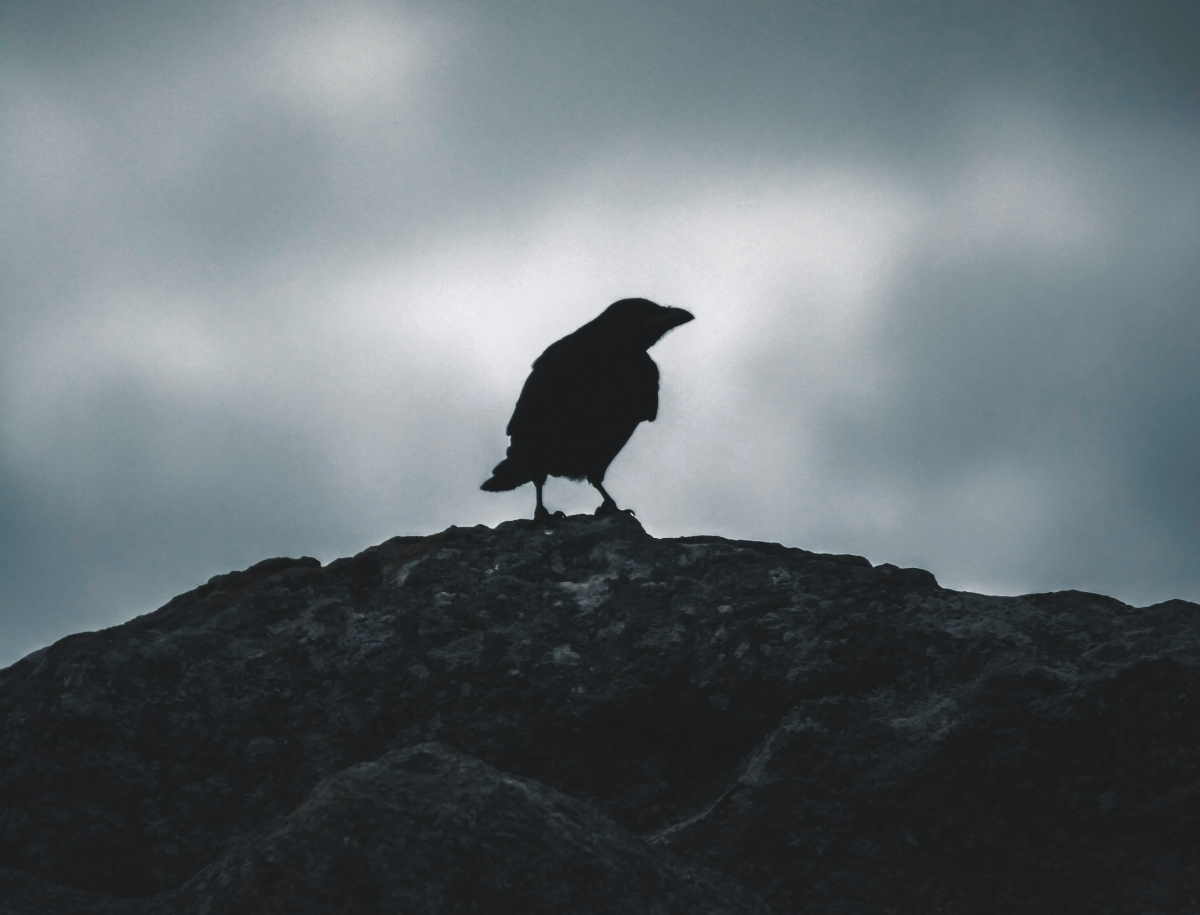
When the character embraces the realization of the crusade of his insecurity (opens the window), The raven comes flying in. The raven is the nigh important symbol in this verse form, which explains the title. This raven is signifying the loss that the graphic symbol has suffered. Through the window of realization, his loss comes flying in to face up him. The raven is described to be grand in its demeanor, much like the loss of Lenore that intimidates him. He is quite fascinated past it and glorifies it. The interesting matter to note here is that the raven takes a seat on the statue of Pallas (Athena goddess of wisdom) which discloses to the reader that this feeling of loss and grief that the grapheme is feeling is literally sitting on his wisdom. It has overpowered his rational idea.
Eighth Stanza
Then this ebony bird beguiling my sorry fancy into smiling,
By the grave and stern decorum of the countenance it wore,
"Though thy crest be shorn and shaven, thou," I said, "art sure no craven,
Ghastly grim and aboriginal Raven wandering from the Nightly shore—
Tell me what thy lordly name is on the Night'due south Plutonian shore!"
Quoth the Raven "Nevermore."
The archway of this raven actually puts a smile on the face of the narrator. The bird was so out of identify in his sleeping accommodation but information technology still "wore" a serious expression as it saturday in that location. The speaker and so turns to treat the raven every bit a noble individual and asks him what his name is in a very dramatic mode. The raven merely replies with 'nevermore'.
When given the chance to face his loss and grief so directly, it seems amusing to the grapheme. And then he speaks to the bird. He asks its (the bird/his grief) proper noun, as information technology looked so m and uncowardly even though it came from the world of suffering (the nighttime nighttime). The raven spoke and said "nevermore". His feelings of grief and loss (the raven) are reminding him of his greatest pain: nevermore. The raven speaks to him conspicuously and relays to him that what he had the deepest desire for in this life of his, is at present strictly nevermore.
9th Stanza
Much I marvelled this ungainly fowl to hear discourse so plainly,
Though its answer little meaning—little relevancy bore;
For nosotros cannot help agreeing that no living human beingness
Ever still was blessed with seeing bird to a higher place his sleeping room door—
Bird or beast upon the sculptured bust to a higher place his bedroom door,
With such name as "Nevermore."
The narrator is very shocked at actually hearing the raven speak equally if it were a natural thing for him. He doesn't empathize how "nevermore" answers the question. So he claims that no one alive or dead has e'er witnessed the scene that was before him: a raven sitting on a statue of Pallas named "nevermore".
Hither, Poe uncovers for his readers that the character was shocked at the scene of facing his loss and grief only to have it and then blatantly speak to him. Phone call to him the reason for his insecurity and weakness: the finality of "nevermore". The graphic symbol claims in this stanza, that no 1 has ever earlier been able to have the experience of meeting loss and grief in physical form. He was "blessed" with this opportunity to come across his feelings and put a name on it: nevermore. That is the core of his grief and loss, the certitude of never living with Lenore once more.
Tenth Stanza
But the Raven, sitting lonely on the placid bust, spoke only
That one word, as if his soul in that 1 discussion he did outpour.
Nothing farther then he uttered—not a plume then he fluttered—
Till I scarcely more than muttered "Other friends have flown before—
On the morrowhe will get out me, as my Hopes have flown earlier."
Then the bird said "Nevermore."
Later on speaking that one word, the raven did not utter another word. He sat there on the statue very still and quiet. The narrator returns to his grim mood and mutters almost having friends who have left him feeling abased, just similar this bird will likely do. On hearing this, the bird over again says:
Nevermore.
The character accepts the existence of this raven in his life and says he expects it to leave every bit others commonly do. Signifying the reality of his emotions; that he feels only similar all other feelings come and become, then will this feeling of intense grief and loss (the raven). The raven speaks out and states: nevermore. Highlighting and foreshadowing that it will not get out. It is going to stay with the character forever.
Eleventh Stanza
Startled at the stillness broken by reply so aptly spoken,
"Doubtless," said I, "what it utters is its simply stock and store
Caught from some unhappy principal whom unmerciful Disaster
Followed fast and followed faster till his songs one burden diameter—
Till the dirges of his Promise that melancholy burden bore
Of 'Never—nevermore'."
The sudden reply from the raven startles the narrator. He comes to the determination that the raven only knows this one word that it has learned from "some unhappy master". He imagines that the master of this raven must have been through a lot of hardships and and so he probably always used the word "nevermore" a bang-up deal, and that is where he believes the bird picked it up.
This stanza is quite interesting as it explores the efforts of the character is trying to ignore the finality of this feeling of grief and loss. He tries to brush information technology off by hoping that possibly the previous possessor of such feelings was a person who emphasized the finality of such feelings so that is why his grief is responding in such a manner. The thought of having to alive with such feelings forever scares the character into denial.
Twelfth Stanza
But the Raven still fallacious all my fancy into grinning,
Straight I wheeled a cushioned seat in front of bird, and bosom and door;
So, upon the velvet sinking, I betook myself to linking
Fancy unto fancy, thinking what this ominous bird of yore—
What this grim, ungainly, ghastly, gaunt, and ominous bird of yore
Meant in husky "Nevermore."
The speaker admits that he cannot help but be fascinated by this raven. He basically sets up his chair then that he is seated right in front of the bird, watching information technology intently. He starts to focus his thoughts on the raven, and what information technology could possibly mean by repeating the specific word of "nevermore".
Hither, the character is clearly getting irritated by the constant presence of such strong feelings. He knows he cannot plow back now, he is the ane who opened the door of his insecurities and weaknesses into his suffering and and so opened the window of realization, to allow this intense feeling of loss and grief to enter and literally perch on his rational thinking / wisdom. What he is finding difficult to swallow is the concept of "nevermore" why can't these feelings be temporary or a stage? Must they eat at him forever?
Thirteenth Stanza
This I sat engaged in guessing, but no syllable expressing
To the fowl whose peppery eyes at present burned into my bust's core;
This and more I sat divining, with my caput at ease reclining
On the cushion's velvet lining that the lamp-light gloated o'er,
Just whose velvet-violet lining with the lamp-lite gloating o'er,
She shall press, ah, nevermore!
He sits there coming up with theories to explain the raven and its behavior to himself, without actually speaking aloud in the visitor of this bird. Even so, he felt equally though its "fiery eyes" could meet through him, straight to his heart. So he continues to ponder and exist lost in thought as he reclines on a soft velvet absorber that the lamplight was highlighting in the room. The sight of the cushion gleaming in the lamplight sends him spiraling into the heart-wrenching reminder that Lenore will never get a adventure to affect that cushion again, at present that she's gone.
Poe underlines the fact that the character has and so much more than feeling than what he tackles when he confronts his grief. Every bit he contemplates over the concreteness of the words "nevermore" he relapses into memories of Lenore. The cushion symbolizes his connexion to his concrete life. As he battles with his emotions, the cushion reminds him that his dearest Lenore will never share his physical infinite and life again. She will never again, physically be in his company.
Fourteenth Stanza
And then, methought, the air grew denser, perfumed from an unseen censer
Swung by Seraphim whose foot-falls tinkled on the tufted flooring.
"Wretch," I cried, "thy God hath lent thee—past these angels he hath sent thee
Respite—respite and nepenthe from thy memories of Lenore;
Quaff, oh quaff this kind nepenthe and forget this lost Lenore!"
Quoth the Raven "Nevermore."
Here the narrator seems to kickoff hallucinating, perhaps he is lost too deep in his thoughts. He starts to feel as though the air around him is getting thicker with perfume or a odor. He thinks he is seeing angels at that place who are bringing this perfume /scent to him. He calls himself a wretch because he feels this is God sending him a message to forget Lenore, comparing the aroma to "nepenthe" which is an illusory medicine for sorrow from ancient Greek mythology. He basically yells at himself to potable this medicine and forget the sadness he feels for the loss of Lenore. About equally if on cue, the raven says: nevermore.
When he comes to the actual realization that he has lost her physical body forever, he begins to panic. He can literally smell the sweetness of freedom from these feelings that he felt God was allowing him. He idea that it was a divine bulletin to forget Lenore and he wants to accept, he wants out and away from his mess of feelings peculiarly from the certainty the grief keeps claiming that information technology will last forever. He tries to forcefulness himself to let it go, but so the raven speaks. His grief overpowers him and all the same claims that he will never forget her.
Fifteenth Stanza
"Prophet!" said I, "affair of evil!—prophet still, if bird or devil!—
Whether Tempter sent, or whether tempest tossed thee here aground,
Desolate withal all undaunted, on this desert state enchanted—
On this home by Horror haunted—tell me truly, I implore—
Is there—is there balm in Gilead?—tell me—tell me, I implore!"
Quoth the Raven "Nevermore."
Now things get pretty heated equally he starts to scream at the bird, calling it a prophet and a thing of evil. He doesn't know what to remember of the bird, did Satan (the tempter) ship this bird his way or did a storm push this bird his way? He continues and describes that even through his shouting the raven is unmoved/unbothered even though it is alone in his company. He calls his home a desert land, haunted and total of horror, and asks the raven if at that place is possible hope of any adept or peace in the time to come, and of form, the raven says: nevermore.
Things get more serious in this stanza every bit the character loses his cool and starts to scream at his emotions. He calls them a prophet because they are basically prophesizing his unhappy life, and a thing of evil because of the pain they are causing him. He doesn't sympathise where such permanence has come up from in his grief and loss. Shouldn't they be a feeling of phase and pass after some time? Why is his feeling here to stay forever? He asks in his panic; whether there is anything good waiting for him in life, will the intensity of such feelings pass? It seems his feelings of grief and loss are ready in stone considering it just replies with a "nevermore".
Sixteenth Stanza
"Prophet!" said I, "thing of evil!—prophet even so, if bird or devil!
Past that Heaven that bends above us—past that God we both admire—
Tell this soul with sorrow laden if, within the afar Aidenn,
Information technology shall clasp a sainted maiden whom the angels name Lenore—
Squeeze a rare and radiant maiden whom the angels name Lenore."
Quoth the Raven "Nevermore."
He continues to call the raven a prophet and a thing of evil equally he dramatically keeps accepting the word of the raven as the answer to his questions. He and so asks for the raven to tell him if he will ever get to hold Lenore again, and predictably the raven says: nevermore.
The character is spiraling into more than anarchy as he realizes he is stuck in this pain and no relief is coming his way. In desperation, he asks whether he will ever hold and embrace his beloved Lenore ever again. The raven crushes him furthermore by maxim no. His feeling of loss intensifies every bit his grief reaffirms for him that the life he had wanted can never ever be his to have and cherish.
Seventeenth Stanza
"Be that word our sign of parting, bird or fiend!" I shrieked, upstarting—
"Get thee dorsum into the storm and the Night'south Plutonian shore!
Leave no blackness plume every bit a token of that lie thy soul hath spoken!
Go out my loneliness unbroken!—quit the bust above my door!
Accept thy beak from out my centre, and accept thy form from off my door!"
Quoth the Raven "Nevermore."
The raven'southward answers throw the narrator into a fit every bit he is consumed by sorrow. He screams at the raven to leave and become back to the tempest it came from and to not even go out a trace of it being present in his chamber. He wants to live in his loneliness without accepting the reality of it. He does not want annihilation to practise with the answers that the bird has given him. He continues to yell at the bird to leave and the raven only replies with: nevermore (implying that it will not become).
At this point in the story, the character is existence consumed by his ain emotions and this mental game that he'due south playing. He screams and cries for his loneliness to stay unbroken considering he realizes that he is no longer alone these emotions and feelings he has unearthed will continue to haunt him and alive with him forever. He yells at these feelings to go away from his wisdom and rational thinking. He pleads for this feeling of intense grief and loss to take the sharp hurting away that he is feeling, and of course as the reader knows for certain past at present, the answer is: nevermore.
Eighteenth Stanza
And the Raven, never flitting, still is sitting,still is sitting
On the pallid bust of Pallas just above my chamber door;
And his eyes take all the seeming of a demon's that is dreaming,
And the lamp-light o'er him streaming throws his shadow on the floor;
And my soul from out that shadow that lies floating on the flooring
Shall be lifted—nevermore!
The speaker ends his story by saying that the raven is however there, sitting on the statue of Pallas; about demon-like in the fashion its eyes gleam. The lamplight hits the raven casting a shadow on the floor, and that shadow has trapped his soul within it and he volition never exist freed from it.
Edgar Allan Poe ends his narrative with a quiet and however character. Quite a modify from the last stanzas; it is about as if he has come to terms with the reality of the situation. As if nosotros are at present watching the character from the exterior of his head, whilst all the commotion is taking place internally. Notwithstanding, the grapheme lets the reader know that all is not well. The raven still sits on the statue of Pallas and it looks demon-like whilst casting a shadow that traps him forever.
That is pregnant because information technology gives the reader closure. It tells the reader that even though the grapheme welcomed the feelings of loss and grief when he opened the window of realization, he despises them now. These emotions appear to him as demonic. And the shadow the cast over him; meaning the mood that is created from these feelings has a permanent hold on his soul. He has been defeated by his feelings afterward facing them, and he volition find peace: nevermore.
Similar Verse
Readers who enjoyed 'The Raven'should as well consider reading some of Poe'south other best-known poems. For example:
- 'A Dream within a Dream,' – published in 1849, this poem examines time and our perceptions of it.
- 'Lone,' – a haunting poem that touches on many of Poe's favorite themes. It was inspired by the expiry of Poe's foster female parent.
- 'Anabel Lee.'– a cute short piece in which Poe'due south speaker describes the death of a young adult female, taken into the afterlife by jealous angels.

Poetic Devices In The Raven,
Source: https://poemanalysis.com/edgar-allan-poe/the-raven/
Posted by: mockporninexpent.blogspot.com
0 Response to "Poetic Devices In The Raven"
Post a Comment